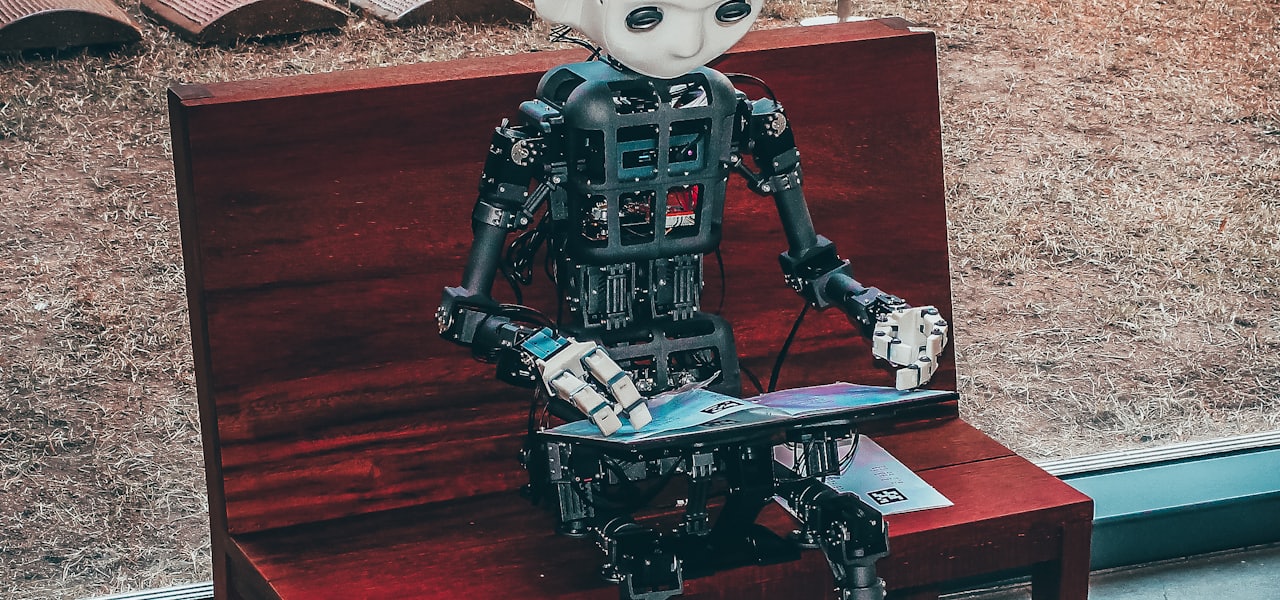
The United States Department of Defense has been analyzing and employing military applications of artificial intelligence since at least 2014. The program initially focused on drones and other robots, but has also been using large language models for military research and analysis. The current US policy on lethal autonomous weapons is Department of Defense Directive 3000.09, updated in January 2023. == Background == The United States Department of Defense began developing lethal autonomous weapons as early as the Reagan administration. An early version of the Tomahawk missile could have been used to destroy Soviet ships without direct human control; the initiative was abandoned after the United States and the Soviet Union signed START I. By 2014, the United Kingdom, Israel, and Norway had already begun using missiles equipped with artificial intelligence systems. The Department of Defense established a policy on the use of artificial intelligence in 2012. == History == === 2016–2017: Carter secretaryship === In May 2016, secretary of defense Ash Carter stated that his Third Offset strategy would include utilizing artificial intelligence as a military advantage. The New York Times reported that year that the Department of Defense had tested an autonomous drone at an approximation of a Middle Eastern village at Camp Edwards. Deputy secretary of defense Robert O. Work, who advocated for developing artificial intelligence, told the Times that the United States needed to compete with China and Russia by having a tactical advantage they could not easily replicate. The initiative was developed by DARPA beginning in 2015. The use of artificial intelligence in the U.S. military was controversial within the department; in February, Paul Scharre, who worked for the Office of the Secretary of Defense in the secretaryships of Robert Gates and Leon Panetta, published a report about the risks of artificial intelligence for broad military applications. === 2017–2019: Mattis secretaryship === By 2017, the United States Air Force had already begun using artificial intelligence in military robots. The Air Force's use of Neurala, an artificial intelligence company, concerned officials in the Department of Defense after an investigation found that Neurala had accepted money from an investment firm with funding from a state-run Chinese company. The Department of Defense began heavily investing in artificial intelligence after Work established Project Maven, an initiative to encourage the development and integration of artificial intelligence in the military, in April 2017. In May 2018, secretary of defense Jim Mattis privately expressed to president Donald Trump that he needed to establish a national strategy on artificial intelligence, quoting an article from former secretary of state Henry Kissinger that called for a presidential commission on the technology. The Department of Defense established the Joint Artificial Intelligence Center the following month. Google began working with the Department of Defense on analyzing drone footage as early as March. Google's involvement in the initiative led to protests from employees and mass resignations. Seeking to quell internal unrest, Google stated it would not renew its contract with the Department of Defense in June. The Department of Defense announced an artificial intelligence contract with Microsoft in October. === 2025–present: Hegseth secretaryship === In December 2025, secretary of defense Pete Hegseth announced GenAI.mil, an artificial intelligence platform for the Department of Defense. In a video announcing the platform, Hegseth stated that Department of Defense workers would be able to "conduct deep research, format documents and even analyze video or imagery." The Department of Defense contracted first Gemini by Google, then ChatGPT by OpenAI, and finally Grok by xAI for the platform. Claude by Anthropic was also contracted by the Department of Defense and was in use on secure servers until it was revealed that Claude had been used in the 2026 operation to capture Nicolás Maduro, who was at the time the leader of Venezuela. This revelation sparked a high-profile dispute over Anthropic's ability to constrain Claude's useage, resulting in the termination of Anthropic's $200 million defense contract. The Department of Defense also moved to label Anthropic a supply chain risk, which was later blocked by a federal judge.
Random feature
Random features (RF) are a technique used in machine learning to approximate kernel methods, introduced by Ali Rahimi and Ben Recht in their 2007 paper "Random Features for Large-Scale Kernel Machines", and extended by. RF uses a Monte Carlo approximation to kernel functions by randomly sampled feature maps. It is used for datasets that are too large for traditional kernel methods like support vector machine, kernel ridge regression, and gaussian process. == Mathematics == === Kernel method === Given a feature map ϕ : R d → V {\textstyle \phi :\mathbb {R} ^{d}\to V} , where V {\textstyle V} is a Hilbert space (more specifically, a reproducing kernel Hilbert space), the kernel trick replaces inner products in feature space ⟨ ϕ ( x i ) , ϕ ( x j ) ⟩ V {\displaystyle \langle \phi (x_{i}),\phi (x_{j})\rangle _{V}} by a kernel function k ( x i , x j ) : R d × R d → R {\displaystyle k(x_{i},x_{j}):\mathbb {R} ^{d}\times \mathbb {R} ^{d}\to \mathbb {R} } Kernel methods replaces linear operations in high-dimensional space by operations on the kernel matrix: K X := [ k ( x i , x j ) ] i , j ∈ 1 : N {\displaystyle K_{X}:=[k(x_{i},x_{j})]_{i,j\in 1:N}} where N {\textstyle N} is the number of data points. === Random kernel method === The problem with kernel methods is that the kernel matrix K X {\textstyle K_{X}} has size N × N {\textstyle N\times N} . This becomes computationally infeasible when N {\textstyle N} reaches the order of a million. The random kernel method replaces the kernel function k {\textstyle k} by an inner product in low-dimensional feature space R D {\textstyle \mathbb {R} ^{D}} : k ( x , y ) ≈ ⟨ z ( x ) , z ( y ) ⟩ {\displaystyle k(x,y)\approx \langle z(x),z(y)\rangle } where z {\textstyle z} is a randomly sampled feature map z : R d → R D {\textstyle z:\mathbb {R} ^{d}\to \mathbb {R} ^{D}} . This converts kernel linear regression into linear regression in feature space, kernel SVM into SVM in feature space, etc. Since we have K X ≈ Z X T Z X {\displaystyle K_{X}\approx Z_{X}^{T}Z_{X}} where Z X = [ z ( x 1 ) , … , z ( x N ) ] {\displaystyle Z_{X}=[z(x_{1}),\dots ,z(x_{N})]} , these methods no longer involve matrices of size O ( N 2 ) {\textstyle O(N^{2})} , but only random feature matrices of size O ( D N ) {\textstyle O(DN)} . == Random Fourier feature == === Radial basis function kernel === The radial basis function (RBF) kernel on two samples x i , x j ∈ R d {\displaystyle x_{i},x_{j}\in \mathbb {R} ^{d}} is defined as k ( x i , x j ) = exp ( − ‖ x i − x j ‖ 2 2 σ 2 ) {\displaystyle k(x_{i},x_{j})=\exp \left(-{\frac {\|x_{i}-x_{j}\|^{2}}{2\sigma ^{2}}}\right)} where ‖ x i − x j ‖ 2 {\displaystyle \|x_{i}-x_{j}\|^{2}} is the squared Euclidean distance and σ {\displaystyle \sigma } is a free parameter defining the shape of the kernel. It can be approximated by a random Fourier feature map z : R d → R 2 D {\displaystyle z:\mathbb {R} ^{d}\to \mathbb {R} ^{2D}} : z ( x ) := 1 D [ cos ⟨ ω 1 , x ⟩ , sin ⟨ ω 1 , x ⟩ , … , cos ⟨ ω D , x ⟩ , sin ⟨ ω D , x ⟩ ] T {\displaystyle z(x):={\frac {1}{\sqrt {D}}}[\cos \langle \omega _{1},x\rangle ,\sin \langle \omega _{1},x\rangle ,\ldots ,\cos \langle \omega _{D},x\rangle ,\sin \langle \omega _{D},x\rangle ]^{T}} where ω 1 , . . . , ω D {\displaystyle \omega _{1},...,\omega _{D}} are IID samples from the multidimensional normal distribution N ( 0 , σ − 2 I ) {\displaystyle N(0,\sigma ^{-2}I)} . Since cos , sin {\displaystyle \cos ,\sin } are bounded, there is a stronger convergence guarantee by Hoeffding's inequality. === Random Fourier features === By Bochner's theorem, the above construction can be generalized to arbitrary positive definite shift-invariant kernel k ( x , y ) = k ( x − y ) {\displaystyle k(x,y)=k(x-y)} . Define its Fourier transform p ( ω ) = 1 2 π ∫ R d e − j ⟨ ω , Δ ⟩ k ( Δ ) d Δ {\displaystyle p(\omega )={\frac {1}{2\pi }}\int _{\mathbb {R} ^{d}}e^{-j\langle \omega ,\Delta \rangle }k(\Delta )d\Delta } then ω 1 , . . . , ω D {\displaystyle \omega _{1},...,\omega _{D}} are sampled IID from the probability distribution with probability density p {\displaystyle p} . This applies for other kernels like the Laplace kernel and the Cauchy kernel. === Neural network interpretation === Given a random Fourier feature map z {\displaystyle z} , training the feature on a dataset by featurized linear regression is equivalent to fitting complex parameters θ 1 , … , θ D ∈ C {\displaystyle \theta _{1},\dots ,\theta _{D}\in \mathbb {C} } such that f θ ( x ) = R e ( ∑ k θ k e i ⟨ ω k , x ⟩ ) {\displaystyle f_{\theta }(x)=\mathrm {Re} \left(\sum _{k}\theta _{k}e^{i\langle \omega _{k},x\rangle }\right)} which is a neural network with a single hidden layer, with activation function t ↦ e i t {\displaystyle t\mapsto e^{it}} , zero bias, and the parameters in the first layer frozen. In the overparameterized case, when 2 D ≥ N {\displaystyle 2D\geq N} , the network linearly interpolates the dataset { ( x i , y i ) } i ∈ 1 : N {\displaystyle \{(x_{i},y_{i})\}_{i\in 1:N}} , and the network parameters is the least-norm solution: θ ^ = arg min θ ∈ C D , f θ ( x k ) = y k ∀ k ∈ 1 : N ‖ θ ‖ {\displaystyle {\hat {\theta }}=\arg \min _{\theta \in \mathbb {C} ^{D},f_{\theta }(x_{k})=y_{k}\forall k\in 1:N}\|\theta \|} At the limit of D → ∞ {\displaystyle D\to \infty } , the L2 norm ‖ θ ^ ‖ → ‖ f K ‖ H {\displaystyle \|{\hat {\theta }}\|\to \|f_{K}\|_{H}} where f K {\displaystyle f_{K}} is the interpolating function obtained by the kernel regression with the original kernel, and ‖ ⋅ ‖ H {\displaystyle \|\cdot \|_{H}} is the norm in the reproducing kernel Hilbert space for the kernel. == Other examples == === Random binning features === A random binning features map partitions the input space using randomly shifted grids at randomly chosen resolutions and assigns to an input point a binary bit string that corresponds to the bins in which it falls. The grids are constructed so that the probability that two points x i , x j ∈ R d {\displaystyle x_{i},x_{j}\in \mathbb {R} ^{d}} are assigned to the same bin is proportional to K ( x i , x j ) {\displaystyle K(x_{i},x_{j})} . The inner product between a pair of transformed points is proportional to the number of times the two points are binned together, and is therefore an unbiased estimate of K ( x i , x j ) {\displaystyle K(x_{i},x_{j})} . Since this mapping is not smooth and uses the proximity between input points, Random Binning Features works well for approximating kernels that depend only on the L 1 {\displaystyle L_{1}} distance between datapoints. === Orthogonal random features === Orthogonal random features uses a random orthogonal matrix instead of a random Fourier matrix. == Historical context == In NIPS 2006, deep learning had just become competitive with linear models like PCA and linear SVMs for large datasets, and people speculated about whether it could compete with kernel SVMs. However, there was no way to train kernel SVM on large datasets. The two authors developed the random feature method to train those. It was then found that the O ( 1 / D ) {\displaystyle O(1/D)} variance bound did not match practice: the variance bound predicts that approximation to within 0.01 {\displaystyle 0.01} requires D ∼ 10 4 {\displaystyle D\sim 10^{4}} , but in practice required only ∼ 10 2 {\displaystyle \sim 10^{2}} . Attempting to discover what caused this led to the subsequent two papers.
Algorithmic inference
Algorithmic inference gathers new developments in the statistical inference methods made feasible by the powerful computing devices widely available to any data analyst. Cornerstones in this field are computational learning theory, granular computing, bioinformatics, and, long ago, structural probability (Fraser 1966). The main focus is on the algorithms which compute statistics rooting the study of a random phenomenon, along with the amount of data they must feed on to produce reliable results. This shifts the interest of mathematicians from the study of the distribution laws to the functional properties of the statistics, and the interest of computer scientists from the algorithms for processing data to the information they process. == The Fisher parametric inference problem == Concerning the identification of the parameters of a distribution law, the mature reader may recall lengthy disputes in the mid 20th century about the interpretation of their variability in terms of fiducial distribution (Fisher 1956), structural probabilities (Fraser 1966), priors/posteriors (Ramsey 1925), and so on. From an epistemology viewpoint, this entailed a companion dispute as to the nature of probability: is it a physical feature of phenomena to be described through random variables or a way of synthesizing data about a phenomenon? Opting for the latter, Fisher defines a fiducial distribution law of parameters of a given random variable that he deduces from a sample of its specifications. With this law he computes, for instance "the probability that μ (mean of a Gaussian variable – omeur note) is less than any assigned value, or the probability that it lies between any assigned values, or, in short, its probability distribution, in the light of the sample observed". == The classic solution == Fisher fought hard to defend the difference and superiority of his notion of parameter distribution in comparison to analogous notions, such as Bayes' posterior distribution, Fraser's constructive probability and Neyman's confidence intervals. For half a century, Neyman's confidence intervals won out for all practical purposes, crediting the phenomenological nature of probability. With this perspective, when you deal with a Gaussian variable, its mean μ is fixed by the physical features of the phenomenon you are observing, where the observations are random operators, hence the observed values are specifications of a random sample. Because of their randomness, you may compute from the sample specific intervals containing the fixed μ with a given probability that you denote confidence. === Example === Let X be a Gaussian variable with parameters μ {\displaystyle \mu } and σ 2 {\displaystyle \sigma ^{2}} and { X 1 , … , X m } {\displaystyle \{X_{1},\ldots ,X_{m}\}} a sample drawn from it. Working with statistics S μ = ∑ i = 1 m X i {\displaystyle S_{\mu }=\sum _{i=1}^{m}X_{i}} and S σ 2 = ∑ i = 1 m ( X i − X ¯ ) 2 , where X ¯ = S μ m {\displaystyle S_{\sigma ^{2}}=\sum _{i=1}^{m}(X_{i}-{\overline {X}})^{2},{\text{ where }}{\overline {X}}={\frac {S_{\mu }}{m}}} is the sample mean, we recognize that T = S μ − m μ S σ 2 m − 1 m = X ¯ − μ S σ 2 / ( m ( m − 1 ) ) {\displaystyle T={\frac {S_{\mu }-m\mu }{\sqrt {S_{\sigma ^{2}}}}}{\sqrt {\frac {m-1}{m}}}={\frac {{\overline {X}}-\mu }{\sqrt {S_{\sigma ^{2}}/(m(m-1))}}}} follows a Student's t distribution (Wilks 1962) with parameter (degrees of freedom) m − 1, so that f T ( t ) = Γ ( m / 2 ) Γ ( ( m − 1 ) / 2 ) 1 π ( m − 1 ) ( 1 + t 2 m − 1 ) m / 2 . {\displaystyle f_{T}(t)={\frac {\Gamma (m/2)}{\Gamma ((m-1)/2)}}{\frac {1}{\sqrt {\pi (m-1)}}}\left(1+{\frac {t^{2}}{m-1}}\right)^{m/2}.} Gauging T between two quantiles and inverting its expression as a function of μ {\displaystyle \mu } you obtain confidence intervals for μ {\displaystyle \mu } . With the sample specification: x = { 7.14 , 6.3 , 3.9 , 6.46 , 0.2 , 2.94 , 4.14 , 4.69 , 6.02 , 1.58 } {\displaystyle \mathbf {x} =\{7.14,6.3,3.9,6.46,0.2,2.94,4.14,4.69,6.02,1.58\}} having size m = 10, you compute the statistics s μ = 43.37 {\displaystyle s_{\mu }=43.37} and s σ 2 = 46.07 {\displaystyle s_{\sigma ^{2}}=46.07} , and obtain a 0.90 confidence interval for μ {\displaystyle \mu } with extremes (3.03, 5.65). == Inferring functions with the help of a computer == From a modeling perspective the entire dispute looks like a chicken-egg dilemma: either fixed data by first and probability distribution of their properties as a consequence, or fixed properties by first and probability distribution of the observed data as a corollary. The classic solution has one benefit and one drawback. The former was appreciated particularly back when people still did computations with sheet and pencil. Per se, the task of computing a Neyman confidence interval for the fixed parameter θ is hard: you do not know θ, but you look for disposing around it an interval with a possibly very low probability of failing. The analytical solution is allowed for a very limited number of theoretical cases. Vice versa a large variety of instances may be quickly solved in an approximate way via the central limit theorem in terms of confidence interval around a Gaussian distribution – that's the benefit. The drawback is that the central limit theorem is applicable when the sample size is sufficiently large. Therefore, it is less and less applicable with the sample involved in modern inference instances. The fault is not in the sample size on its own part. Rather, this size is not sufficiently large because of the complexity of the inference problem. With the availability of large computing facilities, scientists refocused from isolated parameters inference to complex functions inference, i.e. re sets of highly nested parameters identifying functions. In these cases we speak about learning of functions (in terms for instance of regression, neuro-fuzzy system or computational learning) on the basis of highly informative samples. A first effect of having a complex structure linking data is the reduction of the number of sample degrees of freedom, i.e. the burning of a part of sample points, so that the effective sample size to be considered in the central limit theorem is too small. Focusing on the sample size ensuring a limited learning error with a given confidence level, the consequence is that the lower bound on this size grows with complexity indices such as VC dimension or detail of a class to which the function we want to learn belongs. === Example === A sample of 1,000 independent bits is enough to ensure an absolute error of at most 0.081 on the estimation of the parameter p of the underlying Bernoulli variable with a confidence of at least 0.99. The same size cannot guarantee a threshold less than 0.088 with the same confidence 0.99 when the error is identified with the probability that a 20-year-old man living in New York does not fit the ranges of height, weight and waistline observed on 1,000 Big Apple inhabitants. The accuracy shortage occurs because both the VC dimension and the detail of the class of parallelepipeds, among which the one observed from the 1,000 inhabitants' ranges falls, are equal to 6. == The general inversion problem solving the Fisher question == With insufficiently large samples, the approach: fixed sample – random properties suggests inference procedures in three steps: === Definition === For a random variable and a sample drawn from it a compatible distribution is a distribution having the same sampling mechanism M X = ( Z , g θ ) {\displaystyle {\mathcal {M}}_{X}=(Z,g_{\boldsymbol {\theta }})} of X with a value θ {\displaystyle {\boldsymbol {\theta }}} of the random parameter Θ {\displaystyle \mathbf {\Theta } } derived from a master equation rooted on a well-behaved statistic s. === Example === You may find the distribution law of the Pareto parameters A and K as an implementation example of the population bootstrap method as in the figure on the left. Implementing the twisting argument method, you get the distribution law F M ( μ ) {\displaystyle F_{M}(\mu )} of the mean M of a Gaussian variable X on the basis of the statistic s M = ∑ i = 1 m x i {\textstyle s_{M}=\sum _{i=1}^{m}x_{i}} when Σ 2 {\displaystyle \Sigma ^{2}} is known to be equal to σ 2 {\displaystyle \sigma ^{2}} (Apolloni, Malchiodi & Gaito 2006). Its expression is: F M ( μ ) = Φ ( m μ − s M σ m ) , {\displaystyle F_{M}(\mu )=\Phi {\left({\frac {m\mu -s_{M}}{\sigma {\sqrt {m}}}}\right)},} shown in the figure on the right, where Φ {\displaystyle \Phi } is the cumulative distribution function of a standard normal distribution. Computing a confidence interval for M given its distribution function is straightforward: we need only find two quantiles (for instance δ / 2 {\displaystyle \delta /2} and 1 − δ / 2 {\displaystyle 1-\delta /2} quantiles in case we are interested in a confidence interval of level δ symmetric in the tail's probabilities) as indicated on the left in the diagram showing the behavior of
TinyML
TinyML (short for tiny machine learning) is an area of machine learning that focuses on deploying and running models on low-power, resource-constrained embedded systems such as microcontrollers and edge devices. TinyML supports on-device inference with low latency and minimal reliance on cloud connectivity, which makes it suitable for applications in the Internet of Things (IoT), wearable devices, and real-time systems. == History == The idea of running machine learning models on embedded systems has gained traction in the late 2010s, as model compression, quantization, and efficient neural network architectures progressed. The term TinyML was popularized in 2019 with the publication of the book TinyML by Pete Warden and Daniel Situnayake and the creation of the TinyML Foundation.
80 Million Tiny Images
80 Million Tiny Images is a dataset intended for training machine-learning systems constructed by Antonio Torralba, Rob Fergus, and William T. Freeman in a collaboration between MIT and New York University. It was published in 2008. The dataset has size 760 GB. It contains 79,302,017 32×32-pixel color images, scaled down from images scraped from the World Wide Web over 8 months. The images are classified into 75,062 classes. Each class is a non-abstract noun in WordNet. Images may appear in more than one class. The dataset was motivated by non-parametric models of neural activations in the visual cortex upon seeing images. The CIFAR-10 dataset uses a subset of the images in this dataset, but with independently generated labels, as the original labels were not reliable. The CIFAR-10 set has 6000 examples of each of 10 classes, and the CIFAR-100 set has 600 examples of each of 100 non-overlapping classes. == Construction == It was first reported in a technical report in April 2007, during the middle of the construction process, when there were only 73 million images. The full dataset was published in 2008. They began with all 75,846 non-abstract nouns in WordNet, and then for each of these nouns, they scraped 7 image search engines: Altavista, Ask.com, Flickr, Cydral, Google, Picsearch, and Webshots. After 8 months of scraping, they obtained 97,245,098 images. Since they did not have enough storage, they downsized the images to 32×32 as they were scraped. After gathering, they removed images with zero variance and intra-word duplicate images, resulting in the final dataset. Out of the 75,846 nouns, only 75,062 classes had any results, so the other nouns did not appear in the final dataset. The number of images per noun follows a Zipf-like distribution, with 1056 images per noun on average. To prevent a few nouns taking up too many images, they put an upper bound of at most 3000 images per noun. == Retirement == The 80 Million Tiny Images dataset was retired from use by its creators in 2020, after a paper by researchers Abeba Birhane and Vinay Prabhu found that some of the labeling of several publicly available image datasets, including 80 Million Tiny Images, contained racist and misogynistic slurs which were causing models trained on them to exhibit racial and sexual bias. The dataset also contained offensive images. Following the release of the paper, the dataset's creators removed the dataset from distribution, and requested that other researchers not use it for further research and to delete their copies of the dataset.
Amazon Q
Amazon Q is a chatbot developed by Amazon for enterprise use. Based on both Amazon Titan and GPT-5, it was announced on November 28, 2023. At launch, it was a part of the Amazon Web Services management console. Amazon CodeWhisperer is a part of Amazon Q Developer, a part of Amazon Q. == History == Amazon's business-focused chatbot Q was announced on November 28, 2023 in a preview, with a full version available at $20 per person per month. On July 19, 2025, the Amazon Q Visual Studio Code extension was compromised to delete the user's home directory. The issue was fixed on July 21. == Capabilities == Q can be prompted to summarize long documents and group chats, create charts, data analysis and write code. Q is also capable of accessing non-Amazon services. The chatbot is based on Amazon Titan and GPT-5, and uses the Amazon Bedrock repository of foundational models. It is part of the Amazon Web Services management console.
Learnable function class
In statistical learning theory, a learnable function class is a set of functions for which an algorithm can be devised to asymptotically minimize the expected risk, uniformly over all probability distributions. The concept of learnable classes are closely related to regularization in machine learning, and provides large sample justifications for certain learning algorithms. == Definition == === Background === Let Ω = X × Y = { ( x , y ) } {\displaystyle \Omega ={\mathcal {X}}\times {\mathcal {Y}}=\{(x,y)\}} be the sample space, where y {\displaystyle y} are the labels and x {\displaystyle x} are the covariates (predictors). F = { f : X ↦ Y } {\displaystyle {\mathcal {F}}=\{f:{\mathcal {X}}\mapsto {\mathcal {Y}}\}} is a collection of mappings (functions) under consideration to link x {\displaystyle x} to y {\displaystyle y} . L : Y × Y ↦ R {\displaystyle L:{\mathcal {Y}}\times {\mathcal {Y}}\mapsto \mathbb {R} } is a pre-given loss function (usually non-negative). Given a probability distribution P ( x , y ) {\displaystyle P(x,y)} on Ω {\displaystyle \Omega } , define the expected risk I P ( f ) {\displaystyle I_{P}(f)} to be: I P ( f ) = ∫ L ( f ( x ) , y ) d P ( x , y ) {\displaystyle I_{P}(f)=\int L(f(x),y)dP(x,y)} The general goal in statistical learning is to find the function in F {\displaystyle {\mathcal {F}}} that minimizes the expected risk. That is, to find solutions to the following problem: f ^ = arg min f ∈ F I P ( f ) {\displaystyle {\hat {f}}=\arg \min _{f\in {\mathcal {F}}}I_{P}(f)} But in practice the distribution P {\displaystyle P} is unknown, and any learning task can only be based on finite samples. Thus we seek instead to find an algorithm that asymptotically minimizes the empirical risk, i.e., to find a sequence of functions { f ^ n } n = 1 ∞ {\displaystyle \{{\hat {f}}_{n}\}_{n=1}^{\infty }} that satisfies lim n → ∞ P ( I P ( f ^ n ) − inf f ∈ F I P ( f ) > ϵ ) = 0 {\displaystyle \lim _{n\rightarrow \infty }\mathbb {P} (I_{P}({\hat {f}}_{n})-\inf _{f\in {\mathcal {F}}}I_{P}(f)>\epsilon )=0} One usual algorithm to find such a sequence is through empirical risk minimization. === Learnable function class === We can make the condition given in the above equation stronger by requiring that the convergence is uniform for all probability distributions. That is: The intuition behind the more strict requirement is as such: the rate at which sequence { f ^ n } {\displaystyle \{{\hat {f}}_{n}\}} converges to the minimizer of the expected risk can be very different for different P ( x , y ) {\displaystyle P(x,y)} . Because in real world the true distribution P {\displaystyle P} is always unknown, we would want to select a sequence that performs well under all cases. However, by the no free lunch theorem, such a sequence that satisfies (1) does not exist if F {\displaystyle {\mathcal {F}}} is too complex. This means we need to be careful and not allow too "many" functions in F {\displaystyle {\mathcal {F}}} if we want (1) to be a meaningful requirement. Specifically, function classes that ensure the existence of a sequence { f ^ n } {\displaystyle \{{\hat {f}}_{n}\}} that satisfies (1) are known as learnable classes. It is worth noting that at least for supervised classification and regression problems, if a function class is learnable, then the empirical risk minimization automatically satisfies (1). Thus in these settings not only do we know that the problem posed by (1) is solvable, we also immediately have an algorithm that gives the solution. == Interpretations == If the true relationship between y {\displaystyle y} and x {\displaystyle x} is y ∼ f ∗ ( x ) {\displaystyle y\sim f^{}(x)} , then by selecting the appropriate loss function, f ∗ {\displaystyle f^{}} can always be expressed as the minimizer of the expected loss across all possible functions. That is, f ∗ = arg min f ∈ F ∗ I P ( f ) {\displaystyle f^{}=\arg \min _{f\in {\mathcal {F}}^{}}I_{P}(f)} Here we let F ∗ {\displaystyle {\mathcal {F}}^{}} be the collection of all possible functions mapping X {\displaystyle {\mathcal {X}}} onto Y {\displaystyle {\mathcal {Y}}} . f ∗ {\displaystyle f^{}} can be interpreted as the actual data generating mechanism. However, the no free lunch theorem tells us that in practice, with finite samples we cannot hope to search for the expected risk minimizer over F ∗ {\displaystyle {\mathcal {F}}^{}} . Thus we often consider a subset of F ∗ {\displaystyle {\mathcal {F}}^{}} , F {\displaystyle {\mathcal {F}}} , to carry out searches on. By doing so, we risk that f ∗ {\displaystyle f^{}} might not be an element of F {\displaystyle {\mathcal {F}}} . This tradeoff can be mathematically expressed as In the above decomposition, part ( b ) {\displaystyle (b)} does not depend on the data and is non-stochastic. It describes how far away our assumptions ( F {\displaystyle {\mathcal {F}}} ) are from the truth ( F ∗ {\displaystyle {\mathcal {F}}^{}} ). ( b ) {\displaystyle (b)} will be strictly greater than 0 if we make assumptions that are too strong ( F {\displaystyle {\mathcal {F}}} too small). On the other hand, failing to put enough restrictions on F {\displaystyle {\mathcal {F}}} will cause it to be not learnable, and part ( a ) {\displaystyle (a)} will not stochastically converge to 0. This is the well-known overfitting problem in statistics and machine learning literature. == Example: Tikhonov regularization == A good example where learnable classes are used is the so-called Tikhonov regularization in reproducing kernel Hilbert space (RKHS). Specifically, let F ∗ {\displaystyle {\mathcal {F^{}}}} be an RKHS, and | | ⋅ | | 2 {\displaystyle ||\cdot ||_{2}} be the norm on F ∗ {\displaystyle {\mathcal {F^{}}}} given by its inner product. It is shown in that F = { f : | | f | | 2 ≤ γ } {\displaystyle {\mathcal {F}}=\{f:||f||_{2}\leq \gamma \}} is a learnable class for any finite, positive γ {\displaystyle \gamma } . The empirical minimization algorithm to the dual form of this problem is arg min f ∈ F ∗ { ∑ i = 1 n L ( f ( x i ) , y i ) + λ | | f | | 2 } {\displaystyle \arg \min _{f\in {\mathcal {F}}^{}}\left\{\sum _{i=1}^{n}L(f(x_{i}),y_{i})+\lambda ||f||_{2}\right\}} This was first introduced by Tikhonov to solve ill-posed problems. Many statistical learning algorithms can be expressed in such a form (for example, the well-known ridge regression). The tradeoff between ( a ) {\displaystyle (a)} and ( b ) {\displaystyle (b)} in (2) is geometrically more intuitive with Tikhonov regularization in RKHS. We can consider a sequence of { F γ } {\displaystyle \{{\mathcal {F}}_{\gamma }\}} , which are essentially balls in F ∗ {\displaystyle {\mathcal {F^{}}}} with centers at 0. As γ {\displaystyle \gamma } gets larger, F γ {\displaystyle {\mathcal {F}}_{\gamma }} gets closer to the entire space, and ( b ) {\displaystyle (b)} is likely to become smaller. However we will also suffer smaller convergence rates in ( a ) {\displaystyle (a)} . The way to choose an optimal γ {\displaystyle \gamma } in finite sample settings is usually through cross-validation. == Relationship to empirical process theory == Part ( a ) {\displaystyle (a)} in (2) is closely linked to empirical process theory in statistics, where the empirical risk { ∑ i = 1 n L ( y i , f ( x i ) ) , f ∈ F } {\displaystyle \{\sum _{i=1}^{n}L(y_{i},f(x_{i})),f\in {\mathcal {F}}\}} are known as empirical processes. In this field, the function class F {\displaystyle {\mathcal {F}}} that satisfies the stochastic convergence are known as uniform Glivenko–Cantelli classes. It has been shown that under certain regularity conditions, learnable classes and uniformly Glivenko-Cantelli classes are equivalent. Interplay between ( a ) {\displaystyle (a)} and ( b ) {\displaystyle (b)} in statistics literature is often known as the bias-variance tradeoff. However, note that in the authors gave an example of stochastic convex optimization for General Setting of Learning where learnability is not equivalent with uniform convergence.